How to Calm a Quaker Parrot Guarding Its Cage
Wondering how to calm a Quaker parrot guarding its cage? Start by respecting its personal space, rewarding relaxed behaviour and encouraging voluntary interaction. Understanding territorial instincts, reducing stress and building positive experiences around the cage can help your Quaker feel more secure.
One minute, your Quaker is chatting away, enjoying a head scratch and happily spending time with you. The next, you approach the cage and suddenly you're greeted with an open beak, an angry squawk or a determined lunge!
Sound familiar? Cage guarding is something many Quaker parrot owners encounter, and it can be particularly confusing when your bird is affectionate everywhere except inside its cage.
The first thing we'd encourage you to remember is that your Quaker isn't being naughty or deliberately difficult. Its cage is its home, and sometimes your bird simply doesn't appreciate someone entering that space without an invitation.
If you're wondering how to calm a Quaker parrot that becomes defensive around its cage, the secret isn't to challenge its territorial instincts. It's to understand what triggers those reactions and gradually show your bird that having you nearby can be a positive experience.
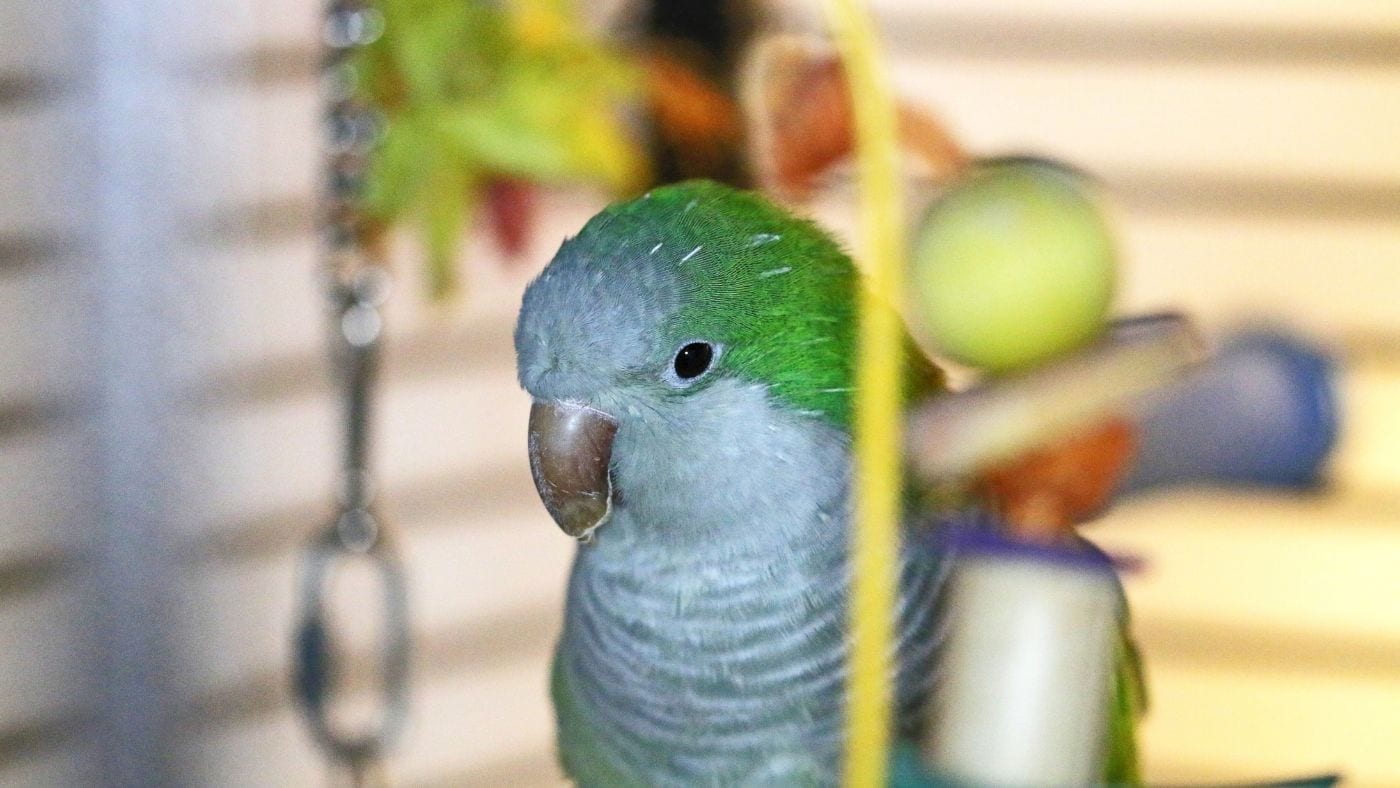
Why Are Quaker Parrots So Protective of Their Cage?
Quakers, also known as Monk Parakeets, have a fascinating natural instinct that helps explain some of their territorial behaviour.
Unlike most parrot species, wild Quakers build elaborate communal nests from sticks. These structures can become surprisingly large, with separate nesting chambers occupied by different pairs. Protecting their nesting space is an important part of their natural behaviour.
Of course, your pet Quaker isn't living in a wild colony, but some of those instincts can still influence how it behaves around its cage.
Think about everything your bird associates with that space. Its favourite sleeping perch, food bowls, treasured toys and somewhere to retreat when the household gets busy. It's hardly surprising that some Quakers become protective of it!
However, territorial instinct isn't always the whole story. Cage guarding can also become stronger when a bird is stressed, experiencing hormonal changes or has previously learned that hands entering the cage lead to unwanted handling.
One useful clue is where and when the behaviour happens. Does your Quaker only lunge when you change its food bowl? Does it become defensive at bedtime? Or is it perfectly happy to interact with you once it has climbed out?
These little details often tell you much more than the bite itself.
Learn to Read Your Quaker's Warning Signs
Parrots are excellent communicators, but we don't always notice what they're telling us until they make their feelings impossible to ignore!
Before lunging or biting, your Quaker might:
- Stiffen its body as you approach the cage.
- Lean forward with an open beak.
- Rush towards the cage door or bars.
- Fan its tail or raise certain feathers.
- Make sharp warning calls or growling sounds.
- Position itself between your hand and a favourite toy or perch.
Eye pinning is another behaviour worth noticing, although it can indicate excitement as well as defensiveness. Always consider your bird's complete body language.
Here's something we think every parrot owner should understand: a warning isn't bad behaviour. It's your bird communicating that something is making it uncomfortable.
If you respond to those early signals by giving your Quaker a little more room, you're showing it that communication works. That's an important part of building trust.
Our guide to parrot body language explores these signals in more detail and can help you recognise when your bird is relaxed, excited or asking for space.
How to Calm a Quaker Parrot Without Forcing Interaction
One of the most important things to understand about how to calm a Quaker parrot is that trust develops through positive experiences, not forced handling. Even small changes in how you approach the cage, offer treats and invite your bird to interact can make everyday life much easier.
When a Quaker starts guarding its cage, our advice is simple: stop making the cage a place where disagreements happen.
You don't need to prove that you can put your hand inside whenever you want. In fact, repeatedly reaching towards a defensive bird can make the problem worse.
Instead, work on changing what your Quaker expects when you approach.
1. Make Your Approach Something to Look Forward To
Imagine your Quaker rushes towards the bars every time you walk over. Rather than immediately opening the door, try approaching only as close as your bird feels comfortable.
Speak gently, offer a favourite treat when your bird is relaxed and then move away again.
That's it! No step-up request, no reaching inside and no pressure to interact.
Repeat this during short sessions. Over time, your Quaker can begin associating your approach with pleasant experiences rather than unwanted interruptions.
If your bird starts lunging before you reach the cage, you're probably moving too close or too quickly. Give it more distance and make the next session easier.
2. Let Your Quaker Come Out on Its Own
One of our favourite ways to work with cage-protective parrots is to move training away from the cage altogether.
When it's safe to do so, open the door and give your Quaker the opportunity to come out voluntarily. A familiar perch or play stand positioned near the entrance can make this much easier.
You can reward your bird for approaching the doorway, stepping onto the outside perch or following a target towards the play area.
For many Quakers, the difference is remarkable. The same bird that fiercely guards its cage may happily interact once it's sitting on a play stand away from its territory.
Just remember that coming out should be your bird's choice. If your Quaker isn't interested, don't chase it around the cage or try to pull it out.
3. Practise Step-Up Training Somewhere Neutral
Once your Quaker is comfortable outside the cage, you have a much better opportunity to practise positive handling.
Start with a handheld perch if your bird is unsure about hands. Offer a favourite reward for stepping onto it, then allow your Quaker to step off again.
As confidence grows, you can gradually introduce stepping onto your hand.
Here's a particularly useful tip: don't make every step-up mean that playtime is over!
If your Quaker learns that stepping onto your hand always results in being returned to its cage, it may understandably become reluctant to cooperate.
Sometimes ask for a step-up, reward your bird and let it return to playing. Make going back into the cage rewarding too.
Make Everyday Cage Care Easier
Food changes, cleaning and rearranging toys can become surprisingly stressful when your Quaker is protective of its belongings.
Where possible, we'd recommend doing more involved cage cleaning while your bird is voluntarily enjoying time on a separate play stand.
For daily tasks, a predictable routine can help enormously:
- Use the same gentle verbal cue before changing food or water.
- Move calmly rather than reaching suddenly towards your bird.
- Use external-access feeding bowls if your cage has them.
- Avoid moving several favourite toys or perches at once.
- Reward your Quaker for remaining comfortable during routine maintenance.
And if your bird is particularly attached to one toy, don't turn removing it into a tug-of-war. Encourage your Quaker to move elsewhere before making changes.
The goal isn't to let your bird dictate every part of its routine. It's to make necessary care predictable and comfortable for everyone.
Could Hormones Be Behind the Cage Guarding?
Sometimes a Quaker that has always been easy-going suddenly becomes much more protective of its cage, particularly around certain corners, toys or enclosed spaces.
Hormonal behaviour may be contributing, especially if your bird is also shredding materials excessively, investigating dark spaces or displaying courtship behaviours.
We recommend looking carefully at the cage setup. Nesting boxes, fabric tents and enclosed hideaways may encourage breeding behaviour in some parrots.
Make sure your Quaker has a consistent sleep routine, plenty of appropriate foraging opportunities and toys it can safely chew and explore.
Also avoid stroking your bird's back or under its wings, as this can encourage sexual behaviour. Stick to head and neck scratches when your Quaker welcomes them.
Hormones are a normal part of parrot life, but they don't explain every behavioural change. If your bird becomes unusually defensive without an obvious reason, it's worth considering whether something else is affecting its comfort.
Can Calming Support Help a Cage-Guarding Quaker?
Absolutely worth considering, particularly when stress is making an already territorial Quaker more reactive.
We've all seen how a change in routine, unexpected visitors or a noisy household can leave a normally confident parrot feeling unsettled. When your bird is already on edge, even everyday activities around its cage can trigger a much stronger response.
Alongside positive reinforcement and a predictable environment, there are two calming ranges worth considering.
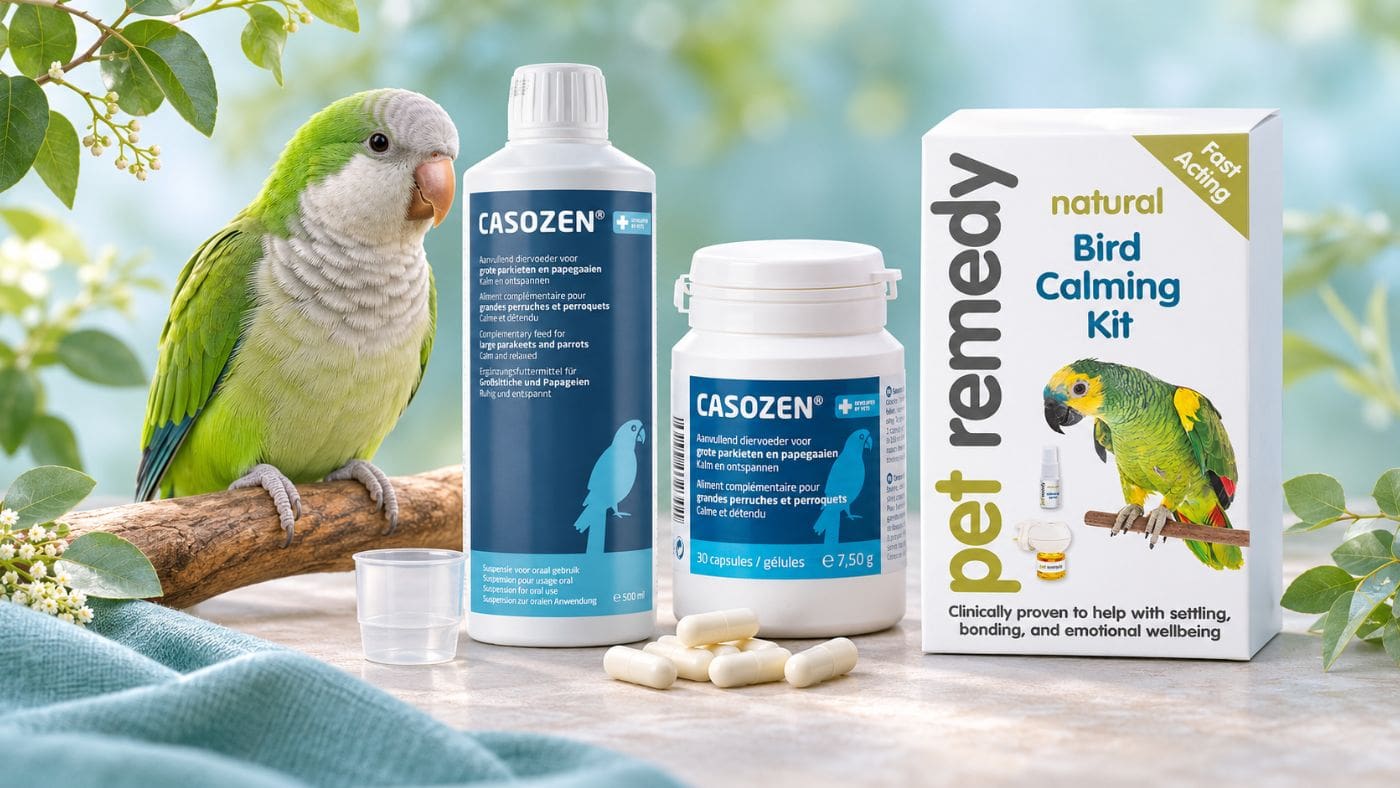
Casozen is a natural, non-sedating calming-support supplement developed for pet birds. Available in capsules and liquid formats, it's designed to support parrots through stressful periods and can be a useful addition when anxiety or environmental changes are contributing to defensive behaviour.
We particularly like that Casozen offers a straightforward way to include calming support in a bird's existing routine. It's prepared in drinking water according to the product instructions, without requiring extra handling of a Quaker that may already be uncomfortable with hands approaching its cage.
Another option we recommend is Pet Remedy, which works differently. Rather than being added to drinking water, Pet Remedy provides calming support through the bird's environment. Its specially formulated blend contains valerian, vetiver, basil and clary sage oils, and the range includes a plug-in diffuser, sprays and wipes.
For a Quaker that becomes particularly unsettled by household activity or changes in its surroundings, Pet Remedy offers a practical environmental approach without needing to interfere with the bird's cage or handling routine. Always follow the instructions for the individual product.
Calming support works best alongside the things that matter most: understanding your Quaker, respecting its boundaries and helping it build confidence. No supplement or environmental product can replace that relationship.
When Is Cage Guarding a Sign That Something Is Wrong?
There's one situation where we wouldn't recommend simply continuing with behaviour training: when a bird suddenly becomes aggressive without any obvious explanation.
Parrots are remarkably good at hiding discomfort. A Quaker experiencing pain may be less willing to step up, become protective of its space or react strongly when someone approaches.
Pay particular attention if the behaviour appears alongside:
- Changes in appetite, weight or droppings.
- Unusual tiredness or spending more time sitting fluffed up.
- Difficulty climbing, balancing or using a foot.
- Reluctance to move or sensitivity to touch.
- A sudden and significant change in normal behaviour.
These signs deserve prompt attention from an avian vet. Once medical causes have been ruled out or addressed, you can return to working on confidence and positive interactions.
What Should You Never Do With a Territorial Quaker?
We understand how frustrating repeated lunging and biting can feel, particularly when you're only trying to feed your bird or clean its cage.
But punishment has no place in building a good relationship with your parrot.
Never shout at your Quaker, tap its beak, force it onto your hand or corner it inside the cage. These reactions can make your bird more fearful and reinforce the very behaviour you're trying to change.
Instead, notice the early warning signs, give your bird space and find an easier way to complete the interaction.
If your Quaker is generally nervous or easily overstimulated, you may also find our 7-day routine for calming a stressed parrot helpful for creating a more predictable daily environment.
How to Calm a Quaker Parrot and Build Lasting Trust
Living with a Quaker means enjoying a parrot with a big personality, plenty of intelligence and, sometimes, some very strong opinions about its personal space!
And that's part of what makes these little parrots so entertaining.
When it comes to how to calm a Quaker parrot guarding its cage, remember that progress isn't measured only by whether your bird allows you to reach inside. Look for the smaller changes too, such as more relaxed body language, voluntary interactions and a growing willingness to spend time with you.
Perhaps your Quaker no longer rushes to the bars when you approach. Maybe it starts coming out voluntarily, accepts a treat with relaxed body language or happily steps onto a perch without hesitation.
Those are meaningful signs that you're building trust.
Our biggest piece of advice is to be consistent and pay attention to what your individual bird is telling you. Every Quaker has its own personality, preferences and experiences. The approach that works beautifully for one bird may need adjusting for another.
With patient training, a comfortable routine and the right support when stress becomes an issue, you can help your Quaker become more confident around its cage while keeping that wonderful, spirited personality intact.
After all, a happy relationship with your parrot isn't about winning every disagreement. It's about understanding each other a little better every day.
FAQs
Why does my Quaker parrot attack me near its cage?
Quakers can become protective of their cage because they see it as their personal territory. Hormones, stress and previous negative experiences can make this behaviour stronger. Pay attention to what triggers the reaction and work on creating positive associations with your approach.
How do I stop my Quaker parrot from lunging at me?
Start by approaching from a distance where your Quaker remains comfortable. Reward relaxed behaviour and gradually work closer. Avoid forcing interaction, especially inside the cage. Encourage your bird to come out voluntarily for training and playtime.
Are Quaker parrots naturally territorial?
Many Quakers have strong territorial instincts, which are linked to their natural nesting behaviour. However, not every Quaker guards its cage, and territorial behaviour can often be managed successfully through consistent training and a suitable environment.
Can calming supplements help my Quaker parrot?
Calming supplements such as Casozen can provide additional support when stress contributes to your Quaker's defensive behaviour. Pet Remedy is another option for environmental calming support. Neither replaces trust-building, training or veterinary care when needed.
Should I remove toys from a territorial Quaker's cage?
Not necessarily. Toys provide essential mental stimulation and help prevent boredom. However, if your Quaker becomes particularly protective of an enclosed toy or nesting space, consider whether it may be encouraging hormonal behaviour. Make changes gradually rather than removing everything at once.